%20WHITE.png)
Mission of the UCCDM
The mission of the UCCDM is to support all settings of the UCC, including but not limited to local congregations, associations, conferences, camps, Historically Underrepresented Groups (HUGs), and national settings, as they seek to recognize and provide access to people with disabilities in all aspects of the church’s life and ministry. The scope of this mission will include but not be limited to:

-
Affirming and claiming as its own the commitments of the UCC to be a multiracial, multicultural, open and affirming [of LGBTQIA+ people], Just Peace, and Accessible to All A2A ministry, recognizing that people with disabilities have a multitude of other identities, and that all justice movements are interconnected;
-
Encouraging all settings of the wider church to be physically, socially, and virtually accessible to and welcoming of people with disabilities;
-
Encouraging and providing guidance to UCC settings as they work to become Accessible to All A2A, and supporting them as they sustain their commitment, and;
-
Participating in denominational and ecumenical conversations related to disabilities and working with the UCC national setting and community partners to promote disability justice through an intersectional framework.
Activities of the UCCDM
The UCCDM is a working Board with several subcommittees, including but not limited to: Advocacy and Education (A&E), Accessible to All (A2A), Disability Theology, and Online Presence. Working as a team, we provide resources to churches and other settings of the UCC to improve accessibility and raise awareness about disability. We collaborate with other UCC ministries to provide consultation on accessibility and to advocate for disability justice.

What does the UCCDM Logo Symbolize?

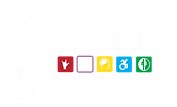
The United Church of Christ Disabilities Ministries (UCCDM) logo is based on the United Church of Christ’s cross and orb logo. The five icons underneath “UCCDM” were intentionally chosen by the UCCDM Board of Directors to symbolize various disabilities.
-
The first icon is a sign language symbol of “I love you” which symbolizes American Sign Language as an aspect of accessibility and inclusion as well as a reminder that God loves persons with disability.
-
The second icon is a box with no symbol which signifies all known disabilities unable to be included in our logo design due to space limitations, as well as disabilities that do not have a known associated symbol. It is a reminder that God has created more than we can anticipate.
-
The third icon includes a human head with the brain highlighted that symbolizes disabilities related to the brain including mental health related disabilities, developmental disabilities, and intellectual disabilities. It is a reminder that we are all “fearfully and wonderfully made” (Psalm 139:14).
-
The fourth icon is the wheelchair Active Symbol of Accessibility. This icon was developed by disability activists at “the accessible icon project” for the public domain as a means of challenging traditional ideas of disability. This symbolizes the importance of people with disabilities defining themselves and as a reminder of the UCCDM’s work for disability and social justice.
-
The fifth and final icon is the icon for hidden, or invisible, disabilities that one cannot see, or discern, by looking at another individual. People with invisible disabilities are often marginalized for not appearing “disabled.” This reminds us that only God sees all things.
The logo was developed by the UCCDM Board of Directors in 2016. The UCCDM Logo is for use by the UCCDM Board of Directors and must be used in its entirety without alteration. The logo cannot be otherwise used without written permission from the UCCDM Executive Committee.
A Timeline History of the UCCDM

1977 – Virginia Kreyer, an ordained American Baptist Minister, joins the United Church of Christ.
1977, 11th General Synod – A resolution passes that leads to the creation of the Advisory Committee on the Church and the Handicap.
Virginia Kreyer
1979 – Advisory Committee on the Church and the Handicap is renamed UCC National Committee on Persons with Handicaps.
1980 – Harold Wilke publishes Creating the Caring Congregation. The book is a “penetrating look at what constitutes a truly caring congregation, it includes everything from the way a church building is designed to the spiritual nature of those specific persons who are handicapped, along with details on how all churches and synagogues can become caring congregations.”

1981 – UCC National Committee of Persons with Handicaps is renamed UCC National Committee on Persons with Disabilities/Handicaps.
1990 – Harold Wilke was present when President Bush signed the Americans with Disabilities Act.
1995 – UCC ADA resolution calls for the church at all levels of the church to be morally bound by the spirit of the ADA. In addition, “Accessible to All” is added to the vision statement of the United Church of Christ.

1997 – UCC Disabilities Ministries played an active planning role in designing Amistad Chapel and a Courtyard which was accessible for service animals.
1997, 21st General Synod – Resolution “Affirming government’s role to protect the common good” is adopted.
1999 – UCC National Committee on Persons with Disabilities/Handicaps goes through one more evolution being known as UCC National Committee on Persons with Disabilities and changes its name to United Church of Christ Disabilities Ministries.
2001 – Virginia Kreyer is first recipient of the Virginia Kreyer Lifetime Achievement Award.
2003 – Harold Wilke passes on February 26.
2005, 25th General Synod – Resolution “Called to Wholeness in Christ: Becoming a Church Accessibility to All” is adopted.
2007 – Virginia Kreyer is named Antoinette Brown Woman.
2009 – On October 17 Margaret (Peg) V. Wilke (Harold Wilke’s Wife and Helpmate) passes.
2012 – Conference Inclusion Teams (CITs) begin to form.
2013 – Virginia Kreyer passes on December 3.
2015, 30th General Synod – Resolution “Developing Welcoming, Inclusive, Supportive and Engaged Congregations for Mental Health” is adopted. Jeannie Tyler (former UCCDM Vice Chair) is awarded Virginia Kreyer Lifetime Achievement Award.

2017, 31st General Synod – Resolution “Toward Disability Justice: A Call to the Church and Churches” is adopted. Lynda Bigler (former UCCDM Chair) is awarded Virginia Kreyer Lifetime Achievement Award.